
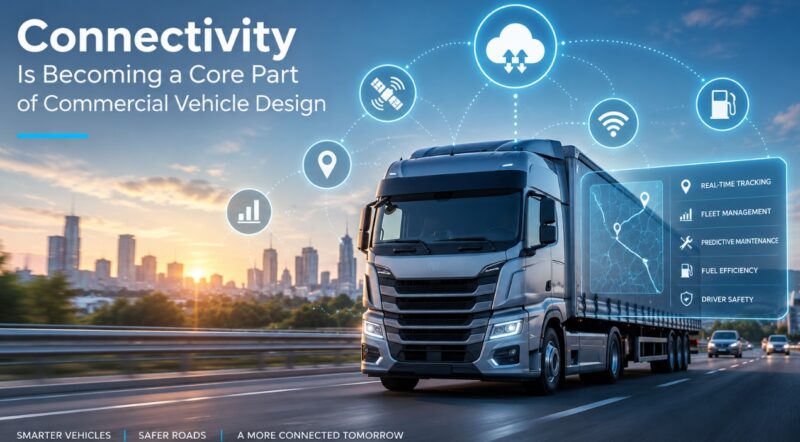
A work truck used to be a pretty simple thing. An engine. A frame. Four wheels and a seat. You bought it, you drove it hard, and you patched it up when it quit on you.
That whole idea is on its way out. These days the folks who build commercial vehicles fuss over connectivity almost as much as they fuss over horsepower.
A truck that can send and receive information has gone from a rare luxury to something buyers just expect.
From Standalone Machine to Connected Tool

For decades, trucks were designed to work largely on their own. The vehicle did its job, and most information about its condition stayed with the driver, the mechanic, or the paperwork back at the yard. That could work for a small local operation where the same people saw the same few vehicles every day. It becomes much harder when a business has hundreds of trucks moving across several regions.
Connectivity closes that gap. A modern truck can report operating data while it is still on the road, allowing the fleet office and service team to see what is happening without waiting for the vehicle to return.
That changes the truck’s role in the business. It is no longer only a machine that carries freight or equipment. It becomes a live source of operational information, connected to dispatch, maintenance planning, routing, and other systems that keep the fleet moving.
What Connectivity Actually Does
A connected truck can feed a steady stream of useful information back to the people managing it. Location is the obvious example, but the picture can go much deeper. Depending on the vehicle and system, a fleet may be able to see fuel use, fault codes, engine conditions, mileage, idle time, service needs, and other operating data.
In practice, that information can support everyday decisions:
- A dispatcher can see where a vehicle is without interrupting the driver.
- A maintenance team can receive a fault alert before the truck returns to the yard.
- Fleet managers can review excessive idling or unusual fuel consumption instead of guessing where waste is occurring.
The value is not simply more data. It is getting useful information soon enough to act on it. Connected diagnostics can help fleets decide whether a warning needs immediate attention or can wait for a planned service stop. Remote monitoring and predictive-maintenance services are already being used by major truck manufacturers for that purpose.
The Hardware That Makes It Work
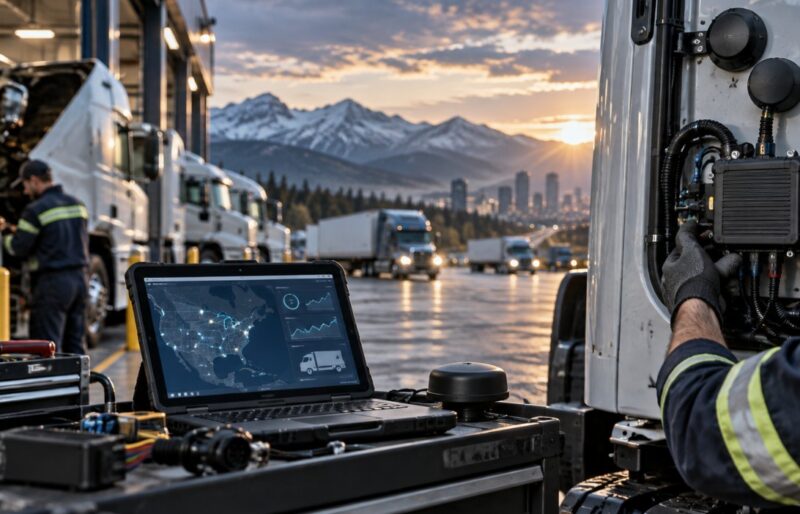
Wiring connection into a vehicle takes a lot more than a good idea. The truck needs tough hardware that keeps humming when conditions turn rough. One hour a rig crawls through downtown traffic. The next it climbs into mountains where the signal just vanishes. The link has to survive both.
That is where the specialist companies earn their keep. Blues IoT keeps vehicles connected anywhere. Their tools make remote asset monitoring a whole lot easier for the businesses that lean on it. Solid hardware like that is what turns a clever concept into something a fleet can truly trust. These parts also have to sip power gently. A gadget that kills the battery would cause bigger problems than it fixes. So engineers sweat over connection tools that run lean and stick around for years.
Software Updates Change the Life of the Truck
Connectivity is also changing what happens after a commercial vehicle leaves the factory. In the past, many software changes required a shop visit, diagnostic equipment, and downtime. With over-the-air capability, some updates and parameter changes can be delivered remotely when the vehicle is parked and the right conditions are met.
That matters because trucks may remain in service for many years. Their software can now evolve during that working life instead of staying frozen at the version installed on delivery. Manufacturers are already using connected platforms for remote updates, diagnostics, and maintenance services. Daimler Truck, for example, offers remote programming and over-the-air updates through connected truck services.
The practical payoff is straightforward. Fleets may avoid certain workshop visits, schedule updates around operations, and apply changes across multiple vehicles without touching each one individually. The vehicle becomes maintainable in two ways: mechanically in the shop and digitally over the network.
Connectivity Has to Be Secure by Design
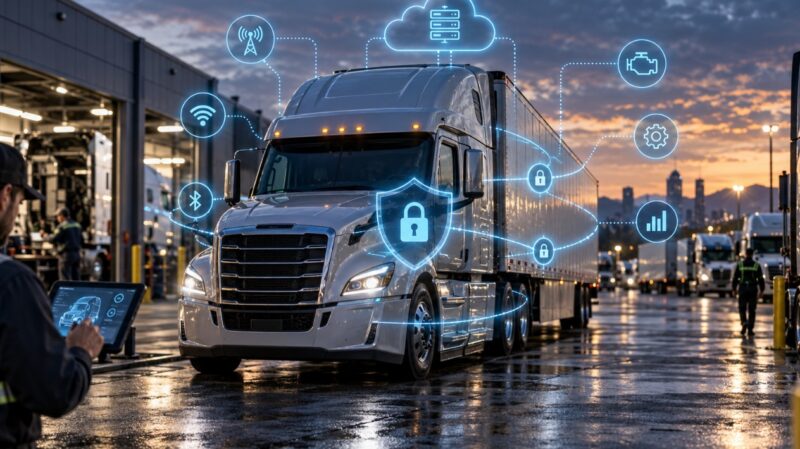
Every new connection into a vehicle creates another path that must be protected. Cellular links, Wi-Fi, Bluetooth, diagnostic interfaces, cloud services, and third-party applications can add useful capabilities, but they also expand the number of places where poor security could create risk.
That is why cybersecurity cannot simply be added after the truck is finished. NHTSA’s vehicle cybersecurity guidance recommends treating outside networks as untrusted and separating wireless-connected systems from safety-critical functions such as braking, steering, propulsion, and power management.
For manufacturers, that affects the vehicle architecture itself. Secure gateways, authentication, network segmentation, software-update controls, and event logging all have to be considered alongside ordinary engineering requirements.
Fleets may never see most of that work, but they depend on it. As commercial vehicles rely more heavily on connected software, convenience has to be balanced with strong protection around critical vehicle systems.
Why Builders Are Making It Standard
Connectivity is steadily moving from optional equipment toward something designed into the vehicle from production. That approach gives manufacturers more control over how communications hardware interacts with the truck’s electronics while giving fleets access to connected services without installing several unrelated aftermarket boxes.
There are a few practical reasons why that matters:
- Installation becomes cleaner. Hardware can be planned around the truck’s electrical and electronic architecture instead of added later.
- Vehicle data can be richer. Factory systems may communicate with more onboard systems than a basic location tracker.
- Services can expand over time. The same connection may later support diagnostics, software updates, traffic information, maintenance tools, or new applications.
The scale is already significant. Volvo Trucks announced in 2025 that it had one million connected trucks operating worldwide, with connected services covering areas including uptime, maintenance planning, vehicle monitoring, and software updates. Connectivity is increasingly becoming a platform the rest of the truck can build on.
Conclusion

Commercial vehicles have moved well beyond the idea of being self-contained machines that reveal their condition only when a warning light appears or a part finally fails. Connectivity now influences how trucks are engineered, serviced, secured, updated, and managed throughout their working lives.
For fleets, the benefit is not simply that a truck happens to be online. The useful part is what that connection makes possible: earlier fault detection, better maintenance planning, remote software work, easier coordination, and a clearer view of what is happening across the operation.
For manufacturers, that means connectivity has to be considered from the first stages of vehicle development. As software takes a larger role in commercial transport, the truck’s communications system is becoming part of its basic architecture rather than another accessory attached after production.
Frequently Asked Questions
1. Does a connected commercial vehicle need cellular coverage all the time?
No. Connected hardware can be designed to store information when service is unavailable and send it later when communication returns. Some transportation IoT systems can also use more than one communications method, including cellular and satellite connections, to improve coverage in remote areas.
2. Can older commercial vehicles be connected too?
Yes. Aftermarket telematics hardware can add location tracking, diagnostics, operating data, and other connected features to many existing trucks. Factory-integrated systems may provide deeper access to vehicle data, but retrofitting remains useful for businesses operating mixed-age fleets.
3. Does connectivity mean somebody can remotely control the truck?
Not automatically. Sending vehicle data, receiving diagnostics, or downloading an approved software update is different from allowing remote control of driving functions. Because wireless interfaces can create new security risks, vehicle cybersecurity guidance calls for strong separation between externally connected systems and safety-critical controls.