
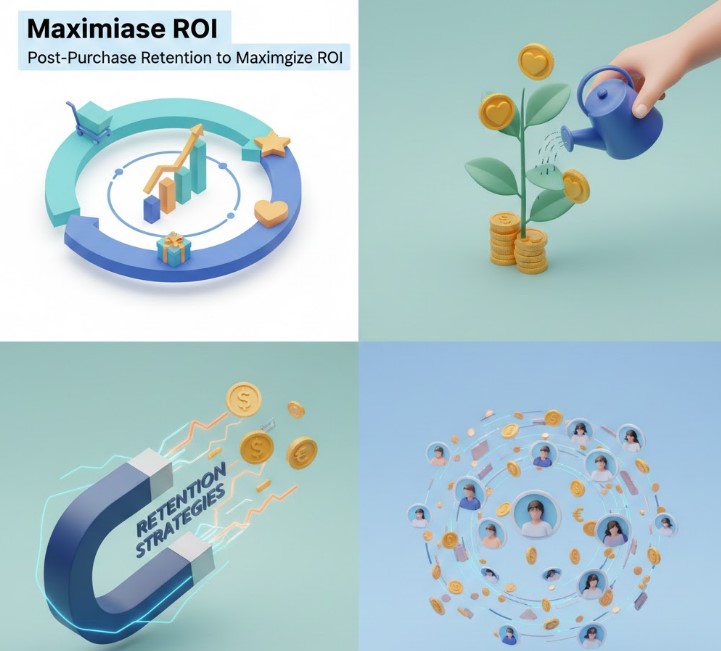
Did you know that increasing customer retention by just 5 percent can lift profits by anywhere from 25 to 95 percent? That stat gets quoted a lot, but it still surprises many teams who focus almost entirely on acquisition. The real ROI often shows up after the checkout, not before it. If you are spending heavily to bring customers in, post-purchase retention strategies are where that investment either compounds or quietly leaks away.
This guide walks through practical, field-tested ways to keep customers engaged after they buy, in a way that feels helpful rather than pushy. Each strategy is designed to be scanned, understood, and applied without fluff or theory overload.
Why post-purchase retention is where ROI is really decided

Most brands underestimate how emotional the post-purchase phase is. Right after buying, customers are looking for reassurance that they made the right choice. This moment shapes whether they return, recommend you, or disappear.
Retention at this stage is not about discounts. It is about clarity, confidence, and follow-through. When done well, it lowers support costs and increases lifetime value at the same time.
Key reasons this phase matters:
- Customers are most attentive right after checkout
- Trust is still forming and can be strengthened or broken
- Small touches here influence repeat behavior more than ads later
If you want to prioritize tools that support this stage, it helps to look at a clear post purchase platforms comparison that shows how different systems handle onboarding, education, and engagement. Seeing options side by side often reveals gaps you did not know you had.
Strategy 1: Set expectations clearly the moment the purchase is complete
Confusion kills retention faster than almost anything else. When customers do not know what happens next, anxiety fills the gap. Your first job after purchase is to remove uncertainty.
This starts with confirmation pages and emails that are genuinely useful, not just transactional. They should answer real questions before customers ask them.
Focus on covering:
- What happens next and when
- How to access what they bought
- Where to go for help if something feels unclear
A short follow-up message within 24 hours can reinforce this. Keep the tone calm and confident. The goal is to make customers feel guided, not managed.
Strategy 2: Onboard with purpose, not volume

Onboarding fails when it tries to do too much at once. Customers do not want everything, they want the next right thing. Good onboarding is paced and intentional.
Think in terms of milestones rather than features. What does success look like in the first day, week, or month? Build communication around that progression.
Effective onboarding often includes:
- One primary action to take first
- A simple explanation of why it matters
- A gentle reminder if it is not completed
Post-purchase onboarding is not education for its own sake. It is guidance toward value realization.
When customers quickly experience value, retention becomes a natural outcome rather than a forced effort.
Strategy 3: Use behavior-based follow-ups instead of generic messaging
Timing matters more than frequency. Sending messages based on customer behavior consistently outperforms fixed schedules. This is where many brands see a measurable ROI lift.
Behavior-based follow-ups feel relevant because they respond to what the customer actually did or did not do. They also reduce noise.
Examples include:
- A check-in if a product has not been used
- A tip triggered by a specific action
- A reminder tied to usage patterns
These messages should be short and focused. One idea per touchpoint is enough. Overloading customers with advice often backfires.
Strategy 4: Turn support moments into retention wins
Support is often treated as a cost center, but it is one of the strongest retention levers you have. How you handle problems matters more than whether problems occur.
Customers who have an issue resolved smoothly often become more loyal than those who never had an issue at all.
A simple framework helps:
- Acknowledge the issue clearly
- Resolve it without friction
- Follow up to confirm satisfaction
Here is how support quality impacts retention outcomes:
| Support experience | Likely retention impact |
| Slow and unclear | High churn risk |
| Fast but cold | Neutral effect |
| Fast and empathetic | Increased loyalty |
The follow-up message after resolution is often overlooked, but it reinforces trust at a critical moment.
Strategy 5: Invite feedback while the experience is still fresh

Feedback is most valuable when it is timely. Waiting months to ask how things are going often produces vague or disengaged responses.
Post-purchase feedback should feel like a conversation starter, not a survey trap. Keep it simple and specific.
Good feedback prompts:
- Ask about one aspect of the experience
- Allow short, open-ended responses
- Show that responses are read and acted on
A quick response to feedback, even just a thank you with context, closes the loop. Customers notice when their input disappears into a void, and they also notice when it does not.
Strategy 6: Re-engage with relevance, not pressure
Not every customer will return on their own. Re-engagement is part of retention, but it should never feel desperate.
The best re-engagement messages reference past value, not missed opportunities. They remind customers why they came in the first place.
Effective re-engagement often includes:
- A reminder of what they achieved or used
- A new, relevant use case
- A low-friction next step
Did you know that reactivation campaigns tied to past behavior can outperform generic promotions by more than double? Context beats incentives almost every time.
Bringing it all together
Post-purchase retention strategies work best when they feel like a natural extension of the buying experience, not a separate marketing machine. The common thread across all of them is respect for the customer’s time, attention, and intent.
Focus on clarity over cleverness. Use behavior to guide timing. Treat support and feedback as opportunities, not obligations. When these pieces align, ROI stops being something you chase and starts being something you build.
Retention is not about doing more. It is about doing the right things at the right moments, consistently.